
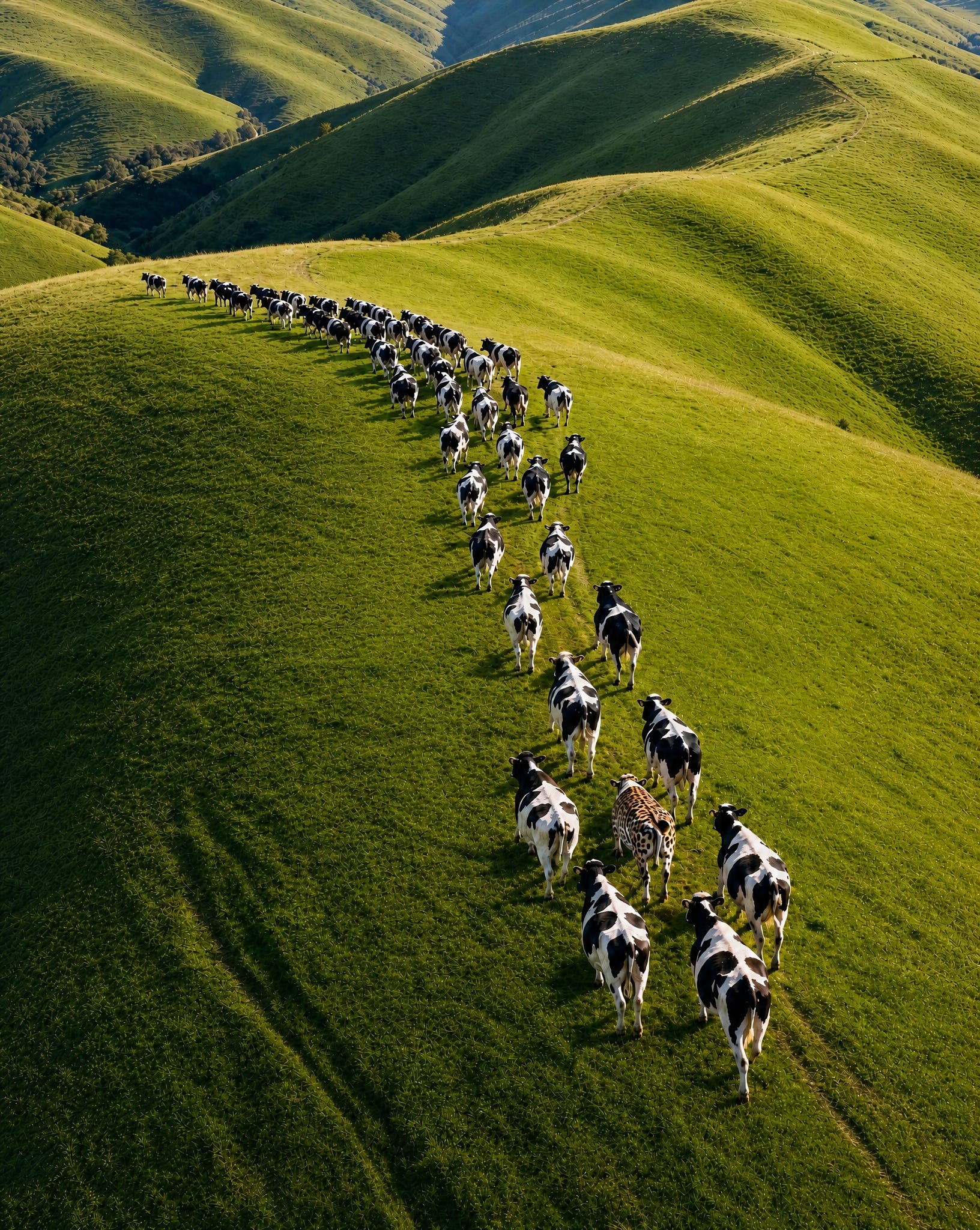
We’re about to have more ideas than we know what to do with.
For most of history, making was the hard part: You could have a brilliant idea for a business without knowing how to build it. Imagine an incredible photograph without having the technical ability to shoot it. Know exactly how you wanted your home to look without being able to render it. Have a book sitting in your head for twenty years without possessing the skill, or perhaps the confidence, to write it.
Making was hard.
So naturally, we built enormous value around the people who knew how to make.
AI will collapse that gap.
Which creates a strange new problem.
When everything can be made, what deserves to be?
I think this is the question that will define creativity in the AI age.
And I suspect the people best equipped to answer it are about to become extremely valuable.
I think creativity (and access to creatives) is about to get very expensive.
Which sounds ridiculous when we’re entering an era where anyone can generate an image, write an essay, build a website, compose music or develop a business idea in seconds.
But that’s exactly why.
Whenever something becomes abundant, value moves somewhere else.
AI is making execution abundant.
So the value moves upstream: to ideas, judgement, taste, curiosity and the ability to see what everyone else missed.
The cheaper it becomes to make, the more valuable it becomes to know what and how it should be made.
When execution becomes abundant, judgement becomes the advantage.
Prediction #1. Execution will become abundant. Judgement will become expensive.
As execution becomes easier, we’re going to find ourselves with an entirely new problem: too much possibility.
Twenty campaign ideas. Fifty logo directions. One hundred headlines. A thousand images.
Who’s going to make the cull? Which idea has life in it? Which one feels derivative? Which is strategically right but creatively boring? Which is culturally interesting? Which could become much bigger than it first appears? Which needs another week? Which should be deleted immediately?
I think we’re moving from an execution economy to a judgement economy.
Taste. Discernment. Editing. Cultural instinct. The ability to recognise something good before everybody else agrees that it’s good.
These skills are notoriously difficult to measure, which is perhaps why we’ve spent so long undervaluing them.
AI might change that.
The more capable our tools become, the less impressive capability becomes.
Prediction #2. Having something to say will matter more than expressing it.
There’s something slightly confronting about being able to make something look finished before you’ve decided whether it’s worth starting.
AI is already very good at this.
It can make an average idea sound intelligent. An obvious idea look beautiful. A derivative idea feel polished.
And I think that’s going to make the thought underneath the work increasingly important.
What do you actually really believe? What have you noticed that I haven’t? What’s your point of view? What do you believe that isn’t already sitting neatly inside the cultural consensus?
For years, I’ve believed that creativity is less about making things and more about seeing things. AI has only strengthened that conviction.
Because increasingly, the machine can help us make.
But seeing is another matter entirely.
Prediction #3. Your weirdest interests will become your competitive advantage.
I collect inspiration compulsively.
My Pinterest boards are chaotic. My camera roll is full of things that would mean absolutely nothing to anybody else: the inscription of a tyre rim, packaging, someone’s kitchen, an unusual colour combination, a screenshot of half a sentence, a shopfront I walked past once, a chair I love but simultaneously have no intention of buying.
Sometimes I save something without even knowing why.
I just know there’s something there.
Months later, it might collide with another completely unrelated reference and suddenly become useful.
I’ve come to think this is how a lot of originality works.
Original people aren’t necessarily inventing things from nothing.
They’re combining from somewhere different.
And I think this becomes important in an AI world.
If we’re all using broadly the same technology, trained on broadly the same body of knowledge, to create broadly similar things, then our advantage lies in the inputs that aren’t shared.
The obscure book you read. The town you visited that nobody talks about. The hobby you’ve had since you were twelve. Your grandmother’s house. The failed business. The person you sat beside at a dinner party. Something your kid said in the car. The rabbit hole you disappeared down at 11pm last night for no commercially useful reason whatsoever.
These things become part of your creative vocabulary.
Perhaps we don’t need to consume more information.
Perhaps we need to consume stranger information?
A rich, peculiar, highly personal bank of references might become one of the most valuable creative assets you can have.
Prediction #4. The people who outsource their thinking will become less creative.
This is the part that makes me slightly uncomfortable.
I use AI constantly. I think it’s extraordinary. It has expanded what I’m capable of doing and dramatically accelerated certain parts of my work.
But I’ve also started noticing a temptation in myself.
The temptation to ask too early.
Why struggle with the opening paragraph when I can generate ten? Why sit with a half-formed idea when I can ask AI to finish it? Why decide what I think before asking what it thinks?
The biggest creative threat of AI may not be replacement.
It may be atrophy.
Creativity is a faculty. And like any faculty, it strengthens through use.
There’s a reason the blank page is frustrating. Sitting with an idea you can’t quite articulate is uncomfortable. Trying something, hating it, starting again, getting distracted, coming back two days later and finally seeing the thing you couldn’t see before is wildly inefficient.
But I wonder if some of that friction does more for us than we realise.
AI can remove the friction from making. We should be careful it doesn’t remove the friction that makes ideas good.
So I’ve started thinking more deliberately about the order in which I use it.
Think first. Ask second.
Arrive with the hunch, the observation, the strange reference, the opinion, the thing I can’t stop thinking about.
Then use my ai friend to help push it further.
I really do believe, the greatest creative risk of the AI age might be becoming extraordinarily capable while slowly losing the ability to think originally.
Prediction #5. Asking great questions will become a superpower.
We’ve spent most of our lives being rewarded for knowing answers.
School taught us that particularly well. Memorise the information. Recall it correctly. Put your hand up. Ahhh, yes: “Good girl”.
Then the internet made answers easier to find.
Now, AI has made them almost instantaneous.
Which makes me wonder if the intellectual advantage is shifting somewhere else entirely.
Towards the question.
Ask AI to “give me ten marketing ideas” and you’ll probably get ten perfectly reasonable marketing ideas.
I like asking questions that are more subversive, and that might the tension points where things get interesting. eg:
What does everyone in this category believe about the customer that might not actually be true?
Or:
What would we do if the convention of this industry didn’t exist?
Or:
What’s the most interesting contradiction inside this problem?
Suddenly you’re somewhere else. Someplace more interesting.
The quality of the output is constrained by the imagination of the question.
And in an age of infinite answers, I think the people capable of asking interesting questions will become disproportionately valuable.
Maybe knowing more isn’t the advantage it once was.
Maybe the advantage is wondering better.
Prediction #6. The most creative people will become insanely more powerful.
For all the anxiety around AI and creative work, this is the prediction I’m most excited about.
I think AI raises the floor. But for genuinely creative people, it also raises the ceiling.
Someone with exceptional taste, curiosity, judgement, cultural instinct and a strong point of view suddenly has access to capabilities that once required significant money, technical expertise or an entire team.
AI can give someone the ability to explore far more possibilities. Prototype faster. Research deeper. Build things they previously couldn’t. Move between disciplines that once required entirely different technical skill sets.
That’s extraordinary leverage.
Which is why I don’t think the interesting divide will be between people who use AI and people who don’t. Soon enough, almost everyone will.
I think the divide will be between people who use AI to replace their thinking and people who use AI to extend it.
The first arrives at the machine empty and asks it what to think.
The second arrives with something of substance.
A hunch. An observation. A strange conviction. A point of view. A question they can’t stop thinking about.
Then they use the machine to interrogate it, stretch it, challenge it and take it somewhere they couldn’t have taken it alone.
One uses AI as a substitute.
The other uses it as leverage.
I suspect the second person is going to become formidable.
We spend a lot of time talking about preparing for the AI age by learning new tools, and of course we should. I’ll absolutely be learning them too.
But I’m equally interested in what we need to protect.
Our curiosity. Our attention. Our taste. Our strange interests. Our willingness to wander. Our ability to sit with an unfinished thought. Our instinct to form an opinion before asking a machine for one.
Perhaps the more artificial intelligence becomes embedded in our lives, the more valuable these distinctly human faculties become.
The thing is, creativity has never really been about how much you can make.
It’s about what you notice. What you connect. What you question. What you choose.
And, increasingly, knowing what deserves to exist in the first place.
The future won’t belong to the people who can make the most. It will belong to the people who can see what is worth making.